
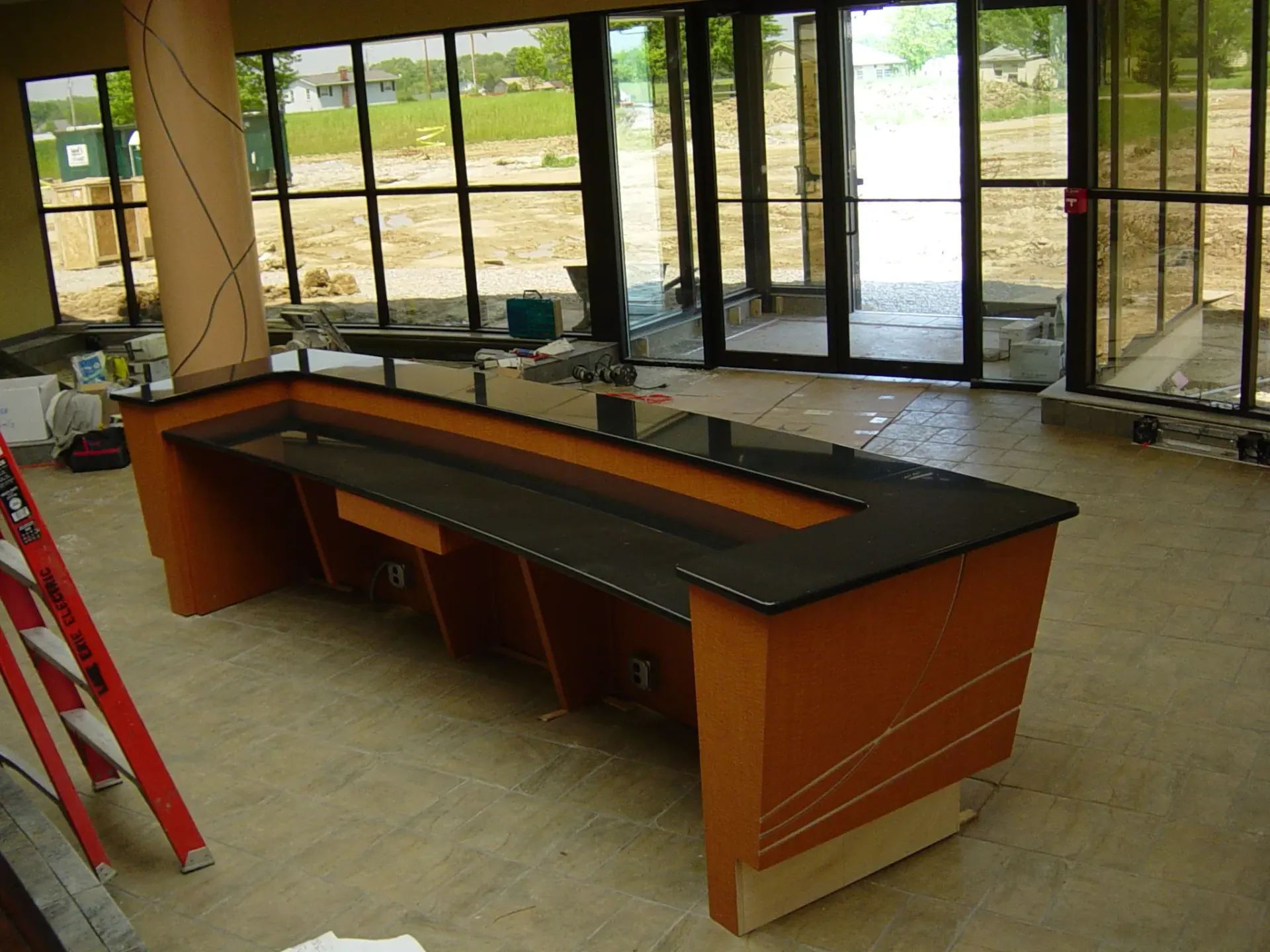
Almost every commercial woodwork spec we read names an AWI grade. Fewer of them make it clear why that grade was picked, or where it should change inside the building. That matters, because the grade decides how tight the gaps are, how the veneer is matched and how closely somebody will look for defects at the walkthrough.
This is a working summary from the shop side. It is not a substitute for the standard itself. AWI revises its standards, so when a number matters on your job, check it against the current edition your spec references.
Where the grades come from
The Architectural Woodwork Institute has published quality standards for decades, and the idea of separate grades goes back to 1961. For years the industry worked from a joint standard that AWI published with AWMAC in Canada and the Woodwork Institute. AWI has since been moving its standards through the ANSI process, product by product. The casework standard, ANSI/AWI 0641, covers wood-veneer and plastic-laminate architectural cabinets under MasterFormat 06 41 xx.
One change worth knowing: the newer casework standard bases structural performance on product testing, with performance duty levels that sit alongside the aesthetic grades. The grades still describe how the work looks and fits. The duty level describes how it holds up to load. If your spec only names a grade, ask your woodworker which duty level they are assuming.
What each grade means
The earlier joint standard put the three grades this way, and most owner design guides still echo it:
- Economy sets the minimum quality requirements for workmanship, materials or installation. It is typically reserved for work that is not in public view, such as mechanical and utility rooms.
- Custom is typically specified for most high-quality architectural woodwork and gives a well-defined level of control over materials, workmanship and installation.
- Premium is typically specified for areas of a project where the highest level of quality, materials, workmanship and installation is required.
Grades can be mixed on one project. They can even be mixed on one item. A state airport authority's design guide gives the example of Premium-grade veneer faces on Custom-grade wood doors.
Why Custom is the commercial default
If a contract references the AWI standards and does not name a grade, the work defaults to Custom. The current AWI installation standard says exactly that, and the earlier casework standard said the same for fabrication.
Owners tend to land there on purpose, too. The university and public-agency design standards we pulled for this article both set Custom as their default unless the designer calls for something else. For offices, clinics, schools and retail back-of-house, Custom is usually the right call. It is tight enough that the work reads as well made, and it doesn't add the labor and material selection that Premium brings.
What actually changes between grades
The differences are mostly about fit, matching and how closely the work is inspected. A published hospital-owner comparison of the grades under the North American standard lays out numbers like these for casework. Treat them as an illustration, since they come from an earlier edition:
- Door and drawer reveals: a nominal 1/8" gap, held to +/- 1/32" at Premium, +/- 1/16" at Custom and +/- 3/32" at Economy.
- Factory-assembled joints: a maximum of .005" by feeler gauge at Premium, .010" at Custom and .015" at Economy.
- Gaps between fixed exposed parts: 1/64" at Premium, 1/32" at Custom and 1/16" at Economy.
- Edgeband flushness with the adjacent surface: .001" at Premium, .005" at Custom and .010" at Economy.
Inspection distance
AWI uses the word "inconspicuous" for some allowable defects, and the distance changes with the grade. The current installation standard defines it as not readily visible without careful inspection at 24 inches for Premium, 48 inches for Custom and 72 inches for Economy. In other words, a Premium reviewer is allowed to stand a lot closer.
Matching and materials
Grain and pattern matching steps up with each grade. Under the earlier casework standard, Economy flush-panel doors and drawer fronts could be mismatched. Custom required doors, drawer fronts and false fronts to run and match vertically within each cabinet unit. Premium added matching across multiple cabinet faces in one elevation, and blueprint or sequence matching still had to be specified separately.
Joinery
Most joinery methods are allowed in all three grades. The lower-cost options, like nailed or stapled square-shoulder drawer joints and through-dado case joints, show up only at Economy in that comparison.
Gaps and flushness are checked with a feeler gauge, and the tolerances apply to the product as installed. How it looked leaving the shop is only half the test. That last part is why installation crews matter as much as the CNC router and the edgebander.
How to call it out in a spec
A few habits make grade callouts work:
- Name the grade in Part 2 of each woodwork section, even if it is Custom. Don't rely on the default.
- Show where it changes. If the lobby desk is Premium and the rest is Custom, say so on the drawings or in a schedule. One university standard asks shop drawings to show the location of different grades, species and finishes. Do it in the bid set and the shop drawings will follow.
- Specify matching separately. Premium does not automatically mean blueprint or sequence-matched veneer. If you want it, write it.
- State the certification requirement, if any. Some owners require AWI's quality certification program for Custom and Premium work and waive it for Economy. If yours does, put it in the bid documents so everyone prices it.
- Reference the edition. Name the standard and year so the shop, the GC and the inspector are reading the same rules.
When Premium is worth the money
Premium buys tighter reveals, closer inspection and better matching. It is worth it where people stand close to the work and where the woodwork is the design: a reception desk, a boardroom, a feature wall in natural veneer, a high-end retail display that customers handle all day.
It is usually not worth it on a run of laminate casework in a staff break room, or on storage behind a door. The earlier standard even put storage, janitor and utility room cabinets at Economy by default. Paying Premium labor on those surfaces does not show.
Our usual advice is to spec Custom as the base, then pick out the few elements that deserve Premium and name them. That gets the money where people will see it.
Getting it right on your job
We build commercial casework and architectural millwork in plastic laminates, solid surface, domestic and exotic veneers and hardwoods, and we work from the grade in your documents. If the grade callout on your project is unclear, or you want help deciding where Premium is worth it, request a quote and send the spec sections along. For a list of what else helps us price accurately, see what to send with a millwork bid request.